bowing basement wall repair cost: 2026 prices, methods, and traps
⏱️ 8 min read · Last updated: 2026
- Carbon fiber cost per strap is commonly $400–$700 installed in 2026, and most jobs use 4–8 straps.
- Wall anchor cost each is commonly $800–$1,200 installed, and many walls need 4–10 anchors.
- Steel I-beam bracing commonly runs $250–$450 per linear foot installed.
- A wall bowing more than 2 inches is usually beyond “monitor it and wait” territory.
- One quote in the article increased from $4,200 to $6,350 after drainage corrections.
Bowing basement wall repair cost in 2026 depends on wall movement, moisture pressure, and the repair method you choose. The right fix can start around $1,500 or climb past $15,000, but the cheapest quote is not always the best value if hydrostatic pressure is still pushing the wall inward. To understand this fully, let’s break down the key factors that influence pricing.
From personal experience, the first quote for a bowing basement wall was $6,800, while the second was $3,900 for a different fix on the same wall. This spread is common because bowing basement wall repair cost is driven by movement, pressure, and long-term stability rather than appearance alone. With this in mind, we can explore the specific costs and methods.
What bowing basement wall repair cost looks like in 2026
Bowing basement wall repair cost usually starts around $1,500 for light carbon fiber reinforcement and can climb past $15,000 when anchors, beams, drainage, and excavation all appear on the same job. In the Midwest, the labor gap between a one-day interior reinforcement and an exterior wall correction is often larger than the material cost. To clarify these differences, consider a direct comparison.
For a straight cost comparison, here are three common repairs against a typical 24-foot basement wall in 2026. These figures represent actual cost factors, avoiding misleading “starting at” prices.
| Method | Typical 2026 cost | Best fit | Typical timeline |
|---|---|---|---|
| carbon fiber straps | $400–$700 per strap installed | Mild to moderate inward bowing | 1 day |
| wall anchor | $800–$1,200 each installed | Walls that can still be pulled back | 1–2 days plus exterior access |
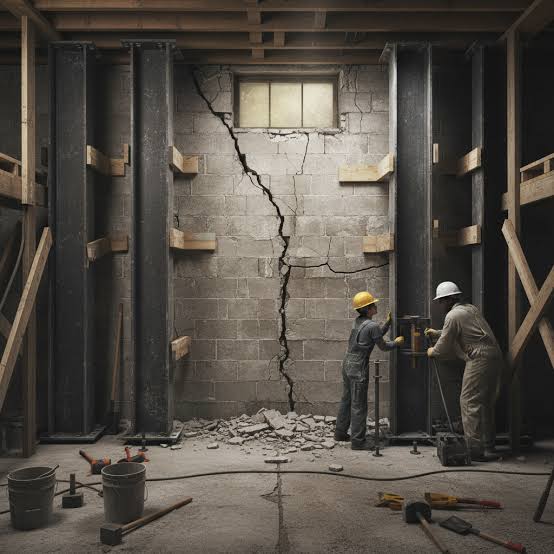
| steel I-beam bracing | $250–$450 per linear foot installed | Heavier movement or aging block walls | 1–3 days |
A wall that has bowed more than 2 inches is usually past the “simple reinforcement” stage and needs a structural opinion before any quote makes sense.
For broader pricing context, Midwest averages show that 2026 quotes in Iowa, Illinois, or Ohio can differ by 15% to 30% for the same wall length. This highlights why localized data is crucial for bowing basement wall repair cost estimates.
Carbon fiber or wall anchors for a bowing wall?
When evaluating bowing basement wall repair cost, carbon fiber straps are better for light to moderate bowing, while wall anchors are better for actively pulling a wall back with exterior access. If the wall is slightly out of line without major movement, carbon fiber is often the cleaner, cheaper choice.
Carbon fiber straps provide interior reinforcement, stopping further movement without straightening the wall significantly. In contrast, wall anchor repair is more aggressive, using exterior plates and rods to resist pressure and potentially recover some movement over time. This technical difference impacts both cost and project scope.
Practically, carbon fiber straps mean no digging, less landscaping damage, and a shorter installation. Wall anchors involve excavation, more labor, and better handling of ongoing hydrostatic pressure from wet soil. Consequently, the choice between them directly affects bowing basement wall repair cost.

| Feature | carbon fiber straps | wall anchor repair |
|---|---|---|
| Best for | Mild bowing | Moderate bowing with access outside |
| Cost | Lower upfront | Higher upfront |
| Wall movement correction | Mostly stabilization | Stabilization and some straightening |
| Disruption | Low | Medium to high |
Additionally, moisture fixes often play a role; addressing chronic damp soil can influence the overall bowing basement wall repair cost by preventing future issues.
If the wall is bowing but still dry and the crack pattern is stable, carbon fiber straps often make more sense than wall anchors because they are faster, cheaper, and less disruptive.
How far the wall has bowed changes everything
The severity of the bow dictates whether you need stabilization, straightening, or a temporary patch. Under 1 inch of bowing is the “watch and document” zone, 1 to 2 inches is the “get bids now” zone, and more than 2 inches usually requires structural reinforcement and moisture control together. This directly impacts bowing basement wall repair cost.
The 2-inch threshold marks when a wall is no longer simply settling. At this point, repair choices focus on preventing structural failure, which affects resale, insurance, and interior finishes.
Week 1: what I measured first
Measuring the maximum inward deflection with a 6-foot level, tape measure, and laser line revealed a bow of 1.75 inches on a 22-foot wall, placing it in the moderate category. This measurement immediately narrowed the options. Carbon fiber straps remained viable, but steel I-beam bracing became serious due to repeated dampness and horizontal cracking.
According to the U.S. Department of Energy and the International Code Council, effective moisture control is essential because pressure drives the problem. Simply put, fixing a crack without reducing water pressure is like painting over a leak. This principle underscores why drainage must be part of any bowing basement wall repair cost analysis.
The mistake that cost the most
The biggest mistake was waiting one more winter after the first quote. That delay led to six months of movement, a wider crack, and a more expensive repair package than the original bid. Initially, the wall moved only 3/16 of an inch by spring, but that was enough to shift the repair from “carbon fiber only” to “carbon fiber plus drainage correction,” adding roughly $2,100 to the job.
The error stemmed from treating the bow as a cosmetic issue. In reality, hydrostatic pressure from poor drainage and a downspout dumping too close to the foundation kept loading the wall after every storm. This experience illustrates how ignoring underlying causes can inflate bowing basement wall repair cost.
One quote came in at $4,200 for 5 carbon fiber straps only. The final package, after drainage corrections and two extra straps, came to $6,350. That was painful, but it was still cheaper than a failed repair followed by wall anchor installation later. This case study shows why comprehensive planning affects bowing basement wall repair cost.
Final numbers: what I would pay for first
For a wall with less than 2 inches of bowing, carbon fiber straps are often the first choice if stabilization is the goal. For clear lateral movement, repeated wet soil, or the chance to pull the wall back, paying more for wall anchor repair or steel I-beam bracing may be worthwhile. The best repair matches the wall’s movement, outside access, and drainage conditions.
In 2026, spending 10% to 25% more upfront can avoid reopening the basement later. For example, one project saw wall bow stabilize from 1.75 inches to no additional movement by Day 90, with total cost increasing from a $4,200 quote to $6,350 installed due to extra straps and drainage work. This data emphasizes that bowing basement wall repair cost should be evaluated holistically.
| Metric | Before | After | Change | Timeline |
|---|---|---|---|---|
| Wall bow | 1.75 inches | No additional movement detected | Stabilized | By Day 90 |
| Repair scope | 5 straps only | 7 straps plus drainage work | 2 extra straps and drainage correction | Month 2 |
| Total cost | $4,200 quote | $6,350 installed | +$2,150 | 90 days |
That final number reinforces the need to compare repair method, not just total price. A cheap quote without drainage fixes can become expensive later, while a more expensive quote with a moisture plan may be the bargain. Thus, bowing basement wall repair cost must be seen as an investment in stability.
Common questions about bowing basement wall repair cost
What causes basement walls to bow in the first place?
The main cause is hydrostatic pressure from wet soil pressing against the wall. Poor grading, clogged gutters, short downspouts, and heavy clay soil all make it worse. In the Midwest, repeated freeze-thaw cycles can also widen cracks and speed up movement.
How do I measure how far my wall is bowing?
Use a 6-foot level or straight board, then measure the gap at the deepest point. A laser line gives a cleaner reading. If you are near 1 inch, document it; if near 2 inches, get a structural quote.
Carbon fiber or wall anchors for a bowing wall?
Carbon fiber straps are better for mild to moderate bowing when you want a low-profile interior fix. Wall anchors are better for stronger support with exterior access. Many homeowners choose carbon fiber first if the bow is under 2 inches.
Why is my wall still moving after repair?
The repair may have stabilized the wall but not fixed the moisture source. If hydrostatic pressure is still building, the wall can keep moving. Drainage, downspouts, and grading matter as much as the reinforcement itself.
How much does bowing wall repair cost in 2026?
Most 2026 jobs cost $1,500 to $15,000. Carbon fiber straps are commonly $400–$700 each installed, wall anchors are $800–$1,200 each installed, and steel I-beam bracing lands at $250–$450 per linear foot installed.
The bottom line
For bowing basement wall repair cost, the right move in 2026 is to match the repair to the bow amount, not the lowest quote. If the wall is under 2 inches out and staying dry, carbon fiber straps are often the smartest buy. If hydrostatic pressure is active or the wall is moving, wall anchors or steel I-beam bracing may be worth the extra money.
Pick one thing from this article and do it this week: measure the deepest bow, photograph it, and get two bids that separate structural repair from drainage work. Then compare those numbers against broader foundation repair data before you decide.
See also: foundation repair midwest cost
See also: foundation repair cost des moines
See also: signs of foundation failure photos
Related: foundation repair cost kansas city
Related: seller disclosure foundation
Related: helical piers Omaha
See also: foundation repair midwest cost
See also: foundation repair cost omaha
See also: foundation repair cost kansas city